Edited transcript of Andrew’s talk at the CTN Southwest breakfast at Toby Carvery on Friday 13 November 2026. Andrew is Chief Innovation Officer at Paddle, the global payments and billing platform, and an elder at Rediscover Church in Exeter, where he leads the worship ministry.
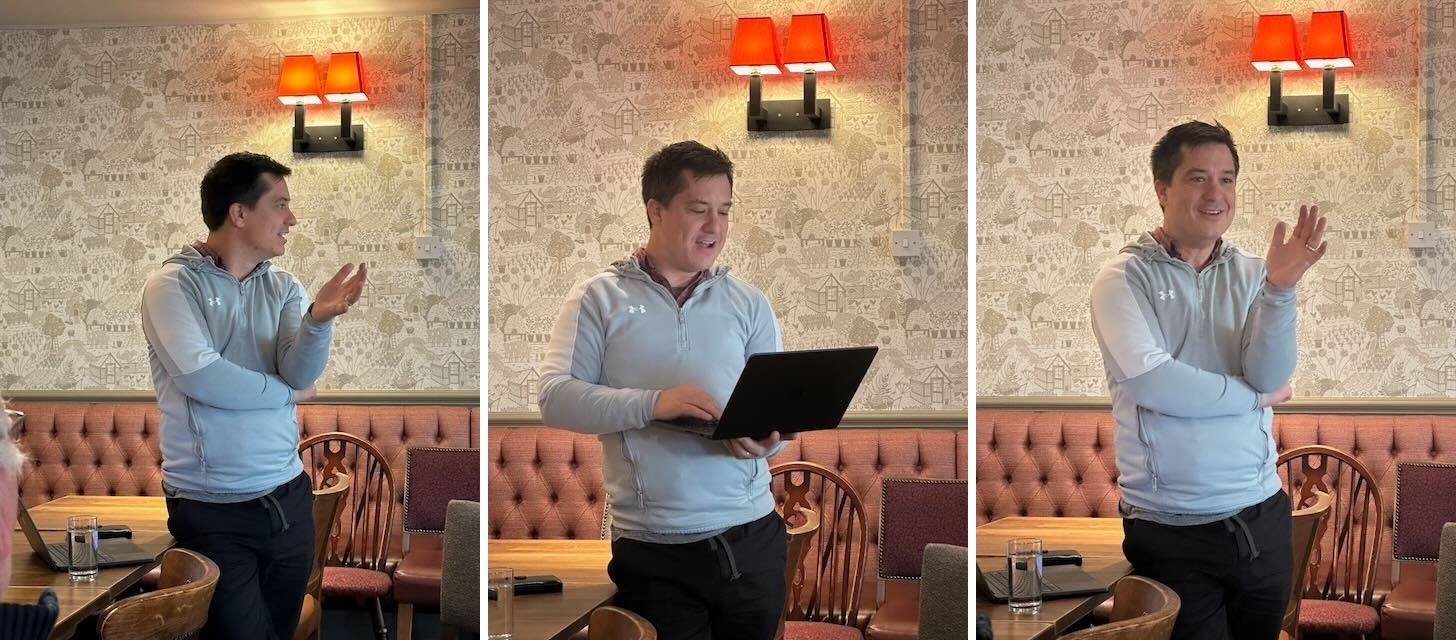
Thank you for welcoming me. I’m an Exeter boy. I wasn’t quite born and bred here, we moved here when I was five. I love being part of Rediscover Church and being part of the wider life of the churches across Exeter.
Like most of us, my Monday is very different from my Sunday. I work in technology, in payments technology. For the last 20 years, since university, I’ve been in early-stage ventures. A lot of that has been building companies, raising money, growing them, selling them, and then trying to start again.
In my current role, I run innovation for a London-based software company with a global customer base. Chief innovation officer sounds like an odd job title in today’s market, where it feels like we’re all being overwhelmed by the pace of innovation. You refresh Sky, or BBC News and something else has happened. There’s something else that makes you feel a bit underwater. So I live with that in my role.
I thought I’d talk about innovation through a couple of questions that have been on my mind. There’s a business book many of you might have read called The Innovator’s Dilemma. I think it was published in 1997. The premise is that great companies can fail to innovate because they don’t take the risk of starting the next thing that might disrupt their own business. They get better at building the organisation they already have, but that can leave them resting on their laurels.
I thought I’d play with that title and talk about a few of the innovator’s dilemmas we face today, and look at some Scriptures along the way.
Are we called to predict or to prophesy?
It might help to give you some background on the company a few colleagues and I built, raised money for and sold in 2019. It was an AI company before AI became what it is today.
Some of you might use ChatGPT or Gemini or one of these models. You might have a whole range of views about them. But at a very fundamental level, these tools work by making predictions. That’s what we were building 10 or 15 years ago. We were building a business around personalisation and the idea of the next best action or the next best piece of content.
For decades there have been systems doing this. If you call Sky or Virgin Media, it can feel as though the system is completely dumb when you’re trying to get through to somebody. But behind those call centres there are systems working out what product to offer you next.
Early on, we did a trial with Virgin to see whether they could keep more customers from cancelling their broadband if they knew which football club the customer supported. If you could talk to somebody about West Brom when they got on the phone, that might help keep them as a customer. The whole idea was the next best thing to say, the next best offer to make or the next action to take.
We built technology that large companies used in their emails and on their websites. We helped them work out what their customers would most likely want to see next.
Artificial intelligence has moved on since then. We now talk about reasoning models and systems that can learn. But prediction is still at the heart of it. You type into ChatGPT, ‘Write me a poem about the sky,’ and it predicts what should come next, word by word and phrase by phrase. It draws on patterns in the material it has been trained on and on the context you’ve given it.
So here’s the first dilemma. As Christians, how much are we meant to be guided by prediction?
Think of the bell curve in statistics. My concern is that a lot of these tools give us something in the middle of that curve. It feels appropriate because it draws on what has happened before. Netflix knows what you’ve watched and predicts the next film or series you might like. In my case, the recommendations might reflect what my children have watched. It might be another episode of Bluey or, when they were younger, another Peppa Pig. Either way, it’s reflecting the tastes of whoever has been watching.
That makes me think of another word that comes up a lot in Scripture. Are we called to predict or are we called to prophesy?
I think we sometimes conflate the two. We can come to think that someone who seems able to predict what’s going to happen is a prophet. But when we look at the Old Testament prophets, they’re asking, ‘What is the word of the Lord in this situation?’ Sometimes the very purpose of speaking is to bring about a response that changes what happens next.
Think of Jonah. He says Nineveh is going to be destroyed. The people repent and the destruction doesn’t happen. By chapter four, Jonah is really annoyed that it hasn’t happened. He hasn’t grasped the mercy and grace of God in that situation.
So what is God’s imagination for the situation we’re in? What’s God’s heart for the industry I’m in? What’s his word for my family, the playground, the boardroom or our region?
We can make predictions about jobs that might be lost, the need for people to learn new skills and the economic challenges that might follow as these tools become more widely used. We also have a calling as Christians to ask what God’s heart is in the middle of all that. What does it look like to live out the kingdom on Monday?
There’s another word beginning with P that comes to mind here, and that’s promise. I was looking again at Shadrach, Meshach and Abednego. They were facing the furnace. They believed God could save them, but they had made a decision about what they were going to do even if he didn’t.
What was their promise in that situation? What was their commitment to act in a way that honoured God, whatever happened? That phrase, ‘even if’, really stands out to me. Even if God doesn’t come through in the way we think he will, what have we already decided we’re going to do?
I believe we’re called to prophesy through how we act, how we respond and what we build. And I think we’re called to be people of promise, people who have made a conscious decision to keep showing up and to stay faithful, whatever the circumstances.
Babel or Bezalel?
The second dilemma is about building. What are we building, how are we building it and why?
In Genesis 11, the people settle on a plain in the land of Shinar. They say to one another, ‘Let’s make bricks and fire them thoroughly.’ They use bricks instead of stone and bitumen for mortar. Then they decide to build a city and a tower that reaches to the heavens, so they can make a name for themselves and avoid being scattered.
There’s real innovation happening there. They’re on a plain where they don’t have the stone they would have used elsewhere. So they make bricks, fire them and use what’s available for mortar. The question is what’s in their hearts as they put that ingenuity to work. ‘Let us make a name for ourselves,’ they say.
They’ve come up with a way to build something impressive. Yet they’re using it to resist the very thing God had asked people to do generations before, which was to spread out and fill the earth.
Then turn over to Exodus 31. This is one of my favourite passages when it comes to the marketplace. God tells Moses that he has called Bezalel by name and filled him with the Spirit of God, with wisdom, understanding, knowledge and skill in all kinds of craftsmanship.
If we stopped after the words ‘filled with the Spirit of God’, we might imagine someone leading worship, preaching a good sermon or looking after people pastorally. What does Bezalel do? He works in gold, silver and bronze. He cuts and sets stones. He carves wood. He’s filled with the Spirit of God for that kind of practical, skilled work. He’s working on the tabernacle.
I find the two stories fascinating to put alongside each other. At Babel, the people say, ‘Let us make a name for ourselves.’ In Exodus, God says he has called Bezalel by name. The people at Babel build upwards towards heaven. Bezalel helps build the tabernacle, the place where God will come and dwell among his people.
There’s a difference in the motive as well. At Babel, there’s fear of being scattered. With the tabernacle, God gives them a pattern to follow and tells them the purpose of the work. He wants to dwell among them.
A few chapters later in Exodus, the people are bringing gifts for the work and eventually they’re told they’ve brought enough. They can stop giving. I find that interesting as well. There’s a sense of contentment and a boundary to the work. They know what they’re building and what’s needed to build it.
It leaves me asking what I’m building, whose purposes it serves and what motive I’m bringing to it.
What’s your section of the wall?
Finally, I get challenged by the sense of overwhelm that comes when the world is moving so fast. In my industry, it can feel like you wake up every day and something has changed. Something has to be built again or taken down, or a competitor has moved ahead of you. It can feel as though things have never gone this fast and they’ll never go this slowly again.
When that happens, the safest option can feel like freezing. That’s another innovator’s dilemma.
I love looking at Nehemiah and the rebuilding of the walls of Jerusalem. If you were simply making a prediction based on what had gone before, all you could see was rubble. The circumstances suggested that it was likely to stay that way.
Nehemiah weeps, fasts and prays. Then he brings the situation before the king, at considerable risk to his own position. He’s afraid and he does it anyway. There’s that sense of ‘even if’ again. I’m going to step into this and say what needs to be said.
In Nehemiah 2, he goes out at night to look at the walls and see where they’ve broken down. He’s collecting the data. He’s finding out what is actually in front of him. He takes it in without being overwhelmed by it.
Then in Nehemiah 3:28, we read about the priests making repairs opposite their own houses. Nobody in that chapter built the whole wall. People took responsibility for the section near them.
God isn’t asking any of us to keep up with the entire pace of change in society or to fix every crisis we see. He’s asking us to build the bit that’s right next to us, the bit where we have some responsibility. That might be the postcode we live in, the workplace we’re in or the playground we’re in.
What’s your section of the wall?
The need to pause
One of the things I’m talking about with people in my world at the moment is how we deal with the frantic pace of progress, particularly in AI and technology. I think one of the biggest defences against that sense of overwhelm is to return to practices the Church has held on to for a long time. I’m thinking about trust and faith, and about Sabbath and rest.
These tools make it incredibly easy to build things. We could open a laptop today, talk for two minutes and watch a website being built in front of us. You can type a simple prompt and get a 3,000 word essay. It might read better than anything I could have written myself. But it may still sit in the middle of that bell curve. Where is the original idea? Where is the prophecy or the promise in it?
That’s why I think we need to pause. I’m speaking to myself more than anyone else here. Those who know me well will know there’s very little pause in my life at the moment. I find it easy to lose those practices, especially in the business world.
I believe it’s in those moments of pause that God can whisper ideas about what could be different around us and what we could go and build.
These are questions I’m asking myself. I hope there’s something in them that’s helpful for you, too.
Questions and discussion
How did your faith become your own, and how do you live it out in a global company?
Andrew Davies: I had the privilege of growing up in a Christian home. I think I was about 15 or 16 when I came along to the church I’m still part of, and my faith became my own.
Part of that was because there were people who saw a calling in me to the marketplace. They helped me see that I could pursue that and that God would be in it. The way they talked about faith gave me a picture of what it could mean for the rest of the week as well as for Sundays.
When I started my first business at university, I asked God for a Christian cofounder. I looked around at Warwick Business School and didn’t find anyone who wanted to do the kind of thing I wanted to do. So I went into business with someone who wasn’t a Christian. We built a good business together, with its ups and downs. My second cofounder wasn’t a Christian either. We built a great company together and sold it, with a good outcome for the shareholders, investors and our teams.
Over the last 10 years or so, I’ve become increasingly interested in what happens when the lines between commercial business and other purposes start to blur. I sit on the board of an organisation in London that trades as a commercial business and gives its profits to charity. That supports things like translation, healthcare and water purification. I find it fascinating to see businesses with that kind of double bottom line, because the businesses I’ve worked in have generally had one clear commercial bottom line.
A few small investments I’ve made have been in businesses that bring those purposes together. One of them is SALT, a Christian dating app. I get investor updates and there’ll be news that people have got married after meeting through it. I met my wife long before there were dating apps, but I find those crossovers really interesting. I think there’ll be more of that in my future.
In my current job, I think my job is to do my job well. It’s to be like Daniel and put systems in place that care for people. It’s to put people first and make that part of how we work.
When we sold the first business, the finance director of one of the venture capital firms that had invested in us came up to me in a pub a few months later. He was a very straight down the line kind of guy. He said something like, ‘Andrew, I don’t know how to say this, but there’s something different about you. You’re just always at peace.’
You don’t always know what people pick up on. My faith doesn’t come up in every Slack message, Teams message or Zoom call. I think my job is to be salt and light in that situation. I like the idea of being a pastor to your workplace. That can take different forms, but often it comes down to paying attention to people who are having a hard time, falling behind or might easily be overlooked.
How should Christians respond to worries about cyber disruption?
Andrew Davies: My first answer is that I don’t think we should worry. I do think we can prepare sensibly. My wife and I were talking about it recently. If there were a disruption, what would it look like to be salt and light? I’d like us to be able to offer someone clean water if they needed it, a place to stay or something to eat. We’re talking about a few ordinary things that would help us look after other people for a day or so.
How do you make time to pause?
Andrew Davies: I’m not very good at this. Many people here are active in their local church on a Sunday, and it can be one of the busiest days of the week. You’re up early, you’re getting to church and there may be several services. I try to make Saturday my Sabbath. Sometimes I’ll work on Sunday after church to get ready for the week, so I try to keep Saturday as my break.
I like Andy Crouch’s writing on this. He talks about the need to step back from what we’re engaging with all the time. That can mean going away for several days without your phone, but it can also come down to what you do every day.
Our children have clear screen time limits on their phones. I have screen time limits on my phone as well. I’m not always very good at obeying them. It isn’t easy. Some of the brightest minds of our generation are making these devices very hard to put down. For me, a lot of it is productivity. I love efficiency. I can get so much done across all my devices, and I need to find a way to turn them off.
A book is one way I get some downtime. It can’t ping me. I can’t respond to a message or look something up on it. I have to sit there and read it.


