Cassie Roberts of ODILS Learning Centre shares how God led her to respond to the urgent needs resulting from increased UK immigration and provides a helpful Christian business perspective on this sensitive issue in our country today.
We are living in a moment of deep cultural tension. Immigration dominates headlines. Opinions are strong. Emotions run high, narratives are loud and for many Christians, it can feel difficult to know how to respond faithfully in the middle of it all.
At a recent CTN gathering, Cassie Roberts, Co-founder and CEO of ODILS, offered something profoundly needed: not a political argument, but a Kingdom perspective. Her message was not shaped by ideology. It was shaped by obedience, 25 years of it. And it carries a quiet but urgent challenge for all of us.
When God redirects a life
Cassie’s story is not one of instant clarity or linear calling. Raised in Birmingham, academically able and entrepreneurial, she built a successful career in recruitment. By her late twenties she was leading teams, managing significant turnover and thriving in a demanding commercial environment. Then everything shifted.
Illness forced her to step back. Redirection followed. Faith came unexpectedly and with it, a prophetic word that at the time made little sense: “You will be a mother of many nations.” Cassie and her husband Russell expected that to mean overseas mission, instead, the Lord spoke something different:
“Stay where you are, I will send the nations to you”
At a leaders’ conference, they sensed the Lord say something unexpected: “Stay where you are. I will send the nations to you.”
At the time, Plymouth was 99% monocultural. It did not look like a place where ‘many nations’ would gather. Cassie remembers standing on the Hoe, praying for the city. She hadn’t seen moving from Birmingham to Plymouth as being ‘sent.’
However, when Plymouth became a dispersal city and people began arriving from conflict zones, suddenly, what seemed unlikely began to make sense. Individuals from countries closed to the Gospel were now finding themselves in the UK.
The opportunity we have been given
During her talk, Cassie expressed something that deserves to be heard carefully: “The Lord has given us an opportunity to reach people who would never have the chance of hearing the Gospel. He is bringing them into this country, as migrants or whichever way, it doesn’t matter. Many of those countries are closed to the Gospel.
“I sometimes get concerned that if we don’t respond to Him actually opening up those worlds to us, we are being disobedient. I don’t say this to criticise, but as aconviction. Historically, it’s usually about 2% of the population of the Church that has any interest whatsoever in anybody outside of their own context. That’s just how it has been. We need to do better, and now we don’t have to go anywhere. The nations are right here.”
For Christian business leaders, that represents huge opportunity.
Who is my neighbour?
Cassie anchored her message in Jesus’ words. When asked about the greatest commandment, He said: “Love the Lord your God with all your heart, soul and mind.” However He didn’t stop there. He said the second is equally important: “Love your neighbour as yourself.”
And when pressed with the question, “Who is my neighbour?” Jesus told the story of the Good Samaritan. The priest saw the injured man and crossed to the other side. The Levite saw him and walked away. The Samaritan, the outsider, stopped, bandaged wounds, paid the cost, and promised to return. Jesus’ conclusion was clear: “Go and do likewise.”
Cassie believes that a true neighbour is defined by action, not identity. Compassion must lead to action — even when it is inconvenient and costly. Titles or roles do not guarantee moral obedience and love extends beyond comfort zones.
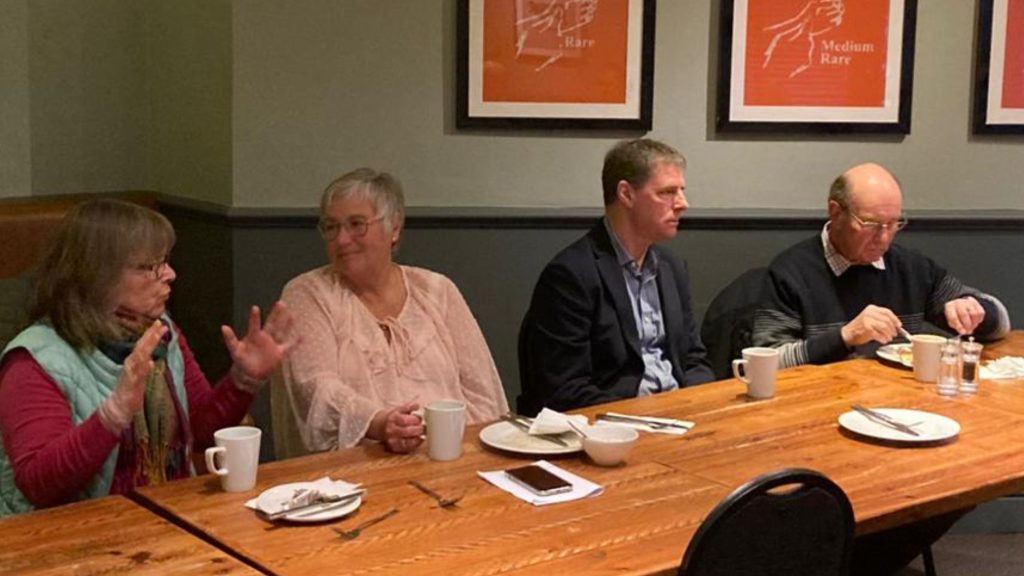
Cassie Roberts (second from the left) at Crosslink Plymouth.
Seeing people as people
For 25 years, ODILS has worked with individuals isolated by language and culture. Cassie emphasises something simple but powerful: people want to serve. They want to work. They want dignity. Many feel shame if they have to receive government support. Many were professionals in their home countries. But systems differ. Qualifications do not always translate. Language becomes the barrier.
ODILS began with £7,000 and faith. Equipment was donated. Cassie received no wages for four years. She and Russ borrowed against their home. They taught English. They built pathways to employment.
Within three months they had 96 students. Over 25 years they have served around 9,500 individuals. But what stood out most in her telling was not the numbers but the impact on each person’s life.
A crossroads for the church
Cassie spoke honestly about the tensions that exist within churches. There are strong opinions. There are fears. There is misinformation. But she brought the focus back to Jesus’ plumb line.
The question is not first political. The question is obedience. If God is opening doors to people from closed nations, if He is bringing individuals who may never otherwise hear the Gospel, how do we respond?
She reminds us that throughout history, the Church has often had a small percentage passionate about the nations. But now, she said, “we’ve got them right here.” We are not being asked to cross oceans. We are being asked whether we will cross the road.
What this means for Christian business
For those leading businesses, this is not abstract theology. Business creates opportunity, employment, culture and can restore dignity.
Cassie’s own journey is proof that commercial skills are not separate from Kingdom calling. Her background in recruitment, leadership and enterprise became essential in building something sustainable. ODILS did not rely purely on grants. It has developed commercial arms, works with local authorities and has pursued excellence in accreditation.
Business principles were not in opposition to mission. They enabled it. Christian enterprise can do the same.
A window of opportunity
Cassie described this season as a window of opportunity. There are moments in history when the Lord opens doors in unexpected ways. Closed nations become reachable, not because policies change overseas, but because people arrive here.
The question for Christian business leaders is not whether the subject is complex. It is. The question is whether we will recognise the opportunity. “Will we see individuals rather than narratives? Will we respond with compassion that moves toward rather than crosses the road? Will we allow fear to shape us or obedience?”
‘Go and do likewise’
Cassie’s message is not dramatic or sensational. It is steady, mature, and rooted in Scripture. Love the Lord your God. Love your neighbour as yourself.
For Christian business leaders, that might look like:
- Creating pathways into employment;
- Partnering with organisations serving those isolated by language;
- Offering mentoring or exposure to workplace culture;
- Choosing engagement over assumption; and
- Leading calmly and Biblically in a polarised environment.
Not everyone is called to reach the nations overseas. But when the nations are here, on our doorstep, the responsibility feels closer. As Cassie reminds us, this may be a moment the Church looks back on one day. A window was open. The nations were present. The opportunity was given. The question is: How did we respond?
About ODILS
ODILS Learning Centre (Open Doors International Language School) is a faith-based charitable enterprise founded in 2001 with a vision to enable people isolated by language and culture to belong and contribute to their communities. Based in Plymouth, ODILS provides high-quality English language education within a caring, relational environment, offering day and evening classes, women and children’s programmes, English for specific purposes, accredited TESOL training, and preparation for recognised language qualifications.
Over the past 25 years, it has served thousands of individuals from across the nations, combining educational excellence with practical pathways into employment and integration. Built on both Kingdom conviction and sound business principles, ODILS operates through a sustainable model that integrates charitable grants, commercial provision, and strategic partnerships, all aimed at restoring dignity, improving economic wellbeing, and strengthening communities.


